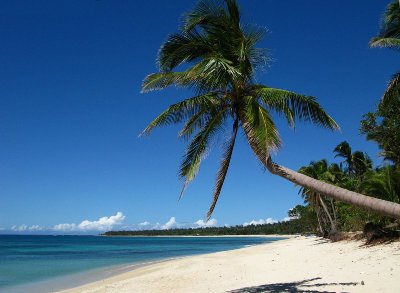
Caunayan Landing Site Pagudpud
The Caunayan Landing Site Pagudpud brings an important chapter of World War II history into your Pagudpud holiday tour. On 27 August 1944, the American submarine USS Stingray delivered personnel, weapons and equipment at Caunayan Bay to support the Philippine resistance movement against the Japanese occupation. Today, the Stingray memorial and historical marker give visitors a place to connect that wartime mission with the coast where it happened.
Include Caunayan in your itinerary to discover a side of Pagudpud that extends beyond the beautiful beaches and scenic drives. A visit offers time to read the plaque inscriptions, appreciate the coastal setting and consider the cooperation between Filipino resistance fighters, American submarine crews and the Australians who helped train them. For travellers interested in history, families exploring together or anyone wanting a fuller understanding of the destination, the site adds meaning to a stay in northern Ilocos Norte. It is sponsored by the Philippine Veterans Bank, and is made from marble, stone and pebble memorial and topped by a 500kg anchor and honours the bolomen and guerrillas of the Philippines and the crews of the 20 special mission American submarines that supplied them with materiel.
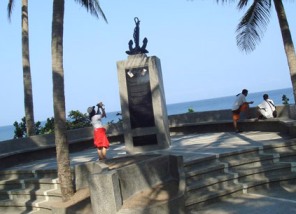
Caunayan Landing Site Pagudpud
This is where the Salmon class submarine USS Stingray SS-186, under the light of a bright half-moon, surfaced off Mayraira Point and covertly beached in August 27, 1944 and then unloaded 15 tons of weapons and supplies for the Ilocano bolomen guerrillas who, with American forces, fought the Japanese and slowly expelled them from Luzon. Fifteen soldiers led by Second Lieutenant Jose V. Valera came ashore with several tons of weapons and equipment. Their mission included finding Governor Roque B. Ablan to assist the Ablan–Madamba guerrillas, who were fighting Japanese occupation forces. The delivery formed part of preparations for the American return to the Philippines. This was a covert support operation rather than a large amphibious invasion. Its importance lay in bringing trained personnel and material to resistance forces already operating ashore. It was this landing that was the start of the beginning of the end for the Japanese occupation forces and liberation. When Macarthur said “I shall return” and this is where that return started, albeit not quite Macarthur.
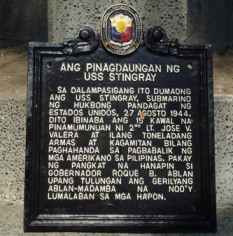
Caunayan Landing Site Pagudpud Monument
The monument is erected in their honor at this landing site where the Stingray landed and is crowned with an anchor, the marble stone and pebbles. The crown symbolizes the anchor that the submarine dropped off the waters as it left the bay and the Caunayan Landing Site.
The US submarine made the decision to drop the anchor after unloading the armaments as lifting it would have created too much noise and then attracted the attention of the Japanese troops patrolling the area. She was surrounded by 21 Japanese vessels, but escaped to deep water without firing a shot.
Ilocos Norte was the scene of fierce fighting between guerilla forces and the Japanese. Prior to the American invasion, the Ilocano guerillas had retaken most of the provincial towns and villages and it was at great cost and sacrifice to do so. The Caunayan Landing Site is important. Lest we forget those who died.
Many civilians were subsequently killed by both the Japanese, and the guerillas as they purged pro-Japanese elements from various communities, towns and villages. In February 1945, it became the first province in northern Luzon to be liberated by guerilla forces. Some Japanese held out until the mid 1970's refusing to surrender.
The Filipino
Resistance
The story of Caunayan includes the Filipino fighters whom the mission was intended to assist. The historical marker specifically identifies the Ablan–Madamba guerrilla organisation and the search for Roque Ablan. It places the arriving team within an existing resistance effort rather than presenting the landing as the beginning of local opposition to occupation.
USS Stingray was an American submarine whose wartime service included
special missions in the Philippines. The Philippine Veterans Affairs Office
describes its role in strengthening resistance forces through the Caunayan
delivery and records that the personnel involved had trained in Brisbane,
Australia.
Caunayan Landing Site Pagudpud - Reading the Coastal Landscape
The coastal setting is an important part of the experience. After reading the marker, turn towards the water and consider the practical challenge of transferring people and equipment from a vessel to shore. The landscape helps give scale and context to an event that might otherwise remain a date and a few lines of text. You do not need a long programme of activities to appreciate the site. A quiet visit with time for reading, photographs and observation can be enough. Let the historical account guide your attention, while recognising that the shoreline and surrounding development may have changed since 1944.
Caunayan Landing Site
Caunayan Landing Site Pagudpud commemorates USS Stingray’s August 1944 delivery of personnel and supplies to support Filipino resistance forces. Visit the memorial and historical marker to discover this wartime connection, appreciate the coastal setting and add a meaningful heritage stop to your Pagudpud itinerary. Caunayan Landing Site for all you need to know.